

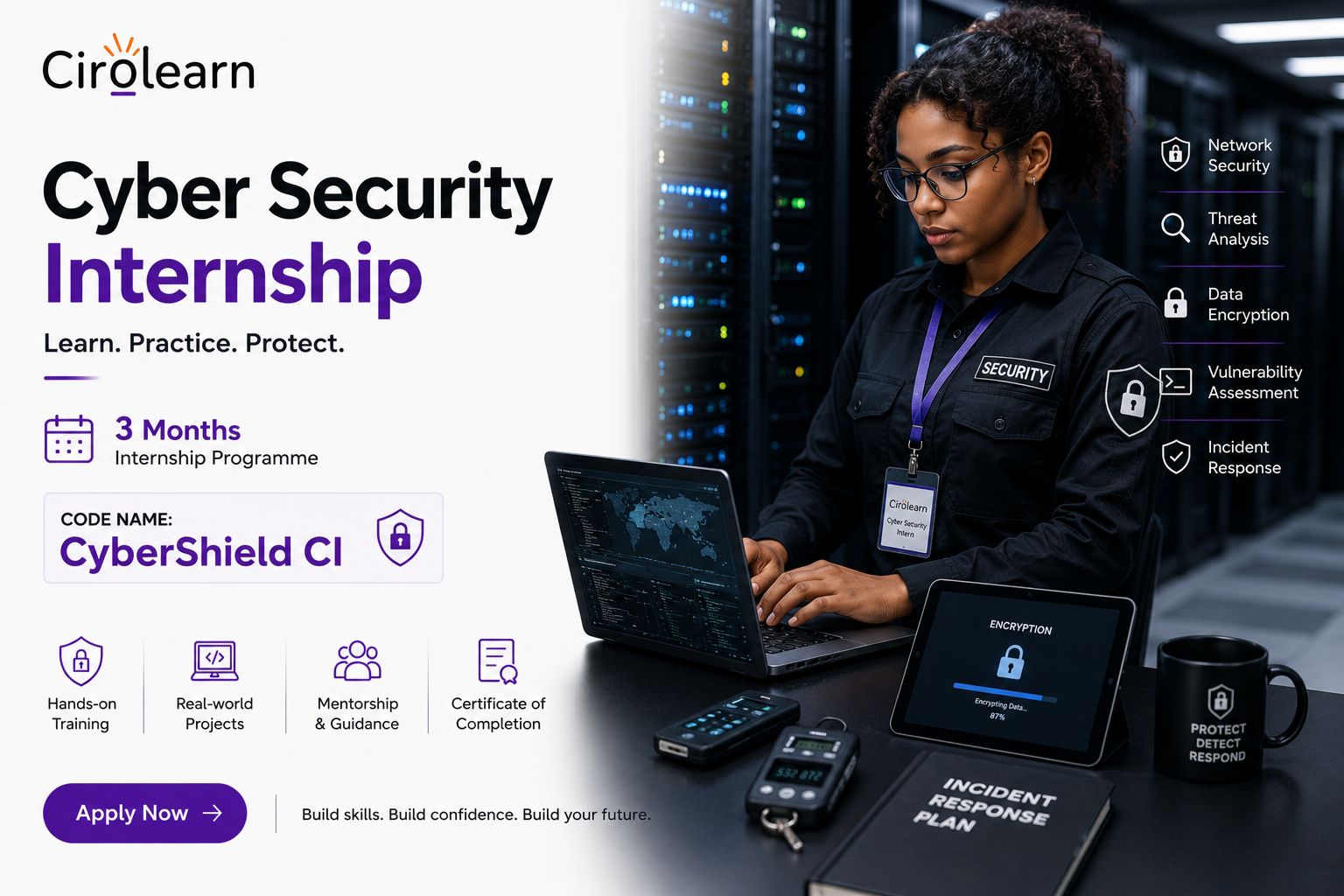
CyberShield CI
Original price was: ₦400,000.00.₦100,000.00Current price is: ₦100,000.00.
Cybersecurity Internship Program
Cybersecurity is the practice of protecting computer systems, networks, applications, digital infrastructure, and sensitive information from cyber threats, unauthorized access, malicious attacks, and security breaches. It involves implementing technologies, processes, and best practices that help organizations safeguard their digital assets while ensuring the confidentiality, integrity, and availability of information.
As businesses, governments, and individuals continue to rely on digital technologies, cybersecurity has become one of the most critical and fastest-growing fields in information technology. Every day, organizations face threats such as phishing attacks, ransomware, malware, data breaches, identity theft, and network intrusions. Cybersecurity professionals play a vital role in preventing these threats, identifying vulnerabilities, responding to incidents, and maintaining secure digital environments.
Modern organizations use cybersecurity to:
- Protect websites and web applications
- Secure business networks and cloud infrastructure
- Safeguard customer and organizational data
- Prevent hacking and cyber attacks
- Detect and respond to security incidents
- Monitor system vulnerabilities
- Protect user identities and accounts
- Ensure compliance with security regulations
- Maintain business continuity
- Support safe digital operations
Cybersecurity is essential across nearly every industry, including:
- Technology
- Finance and Banking
- Healthcare
- Government
- Telecommunications
- E-commerce
- Education
- Energy
- Manufacturing
- Logistics
- Insurance
- Consulting
- Media and Entertainment
As cyber threats continue to evolve, the demand for skilled cybersecurity professionals continues to increase worldwide, making cybersecurity one of the most rewarding and future-proof career paths in technology.
About the Internship
The Cirolearn Cybersecurity Internship Program is designed to provide students with practical, hands-on experience in cybersecurity operations, ethical hacking, vulnerability assessment, digital defense, and security analysis.
Rather than focusing solely on theoretical concepts, the program emphasizes practical learning through real-world simulations, security labs, guided exercises, and industry-inspired projects that mirror the responsibilities of cybersecurity professionals working in modern organizations.
Throughout the internship, participants will learn how to identify security risks, secure digital systems, analyze cyber threats, and apply industry best practices to protect organizational infrastructure.
What You Will Learn
During the internship, students will develop practical skills in:
Introduction to Cybersecurity
Students will learn:
- Cybersecurity fundamentals
- Cybersecurity career paths
- Types of cyber threats
- Security principles
- The CIA Triad (Confidentiality, Integrity, Availability)
- Risk management fundamentals
Computer Networking Fundamentals
Students will gain a strong understanding of:
- Network architecture
- TCP/IP
- IP addressing
- DNS
- HTTP/HTTPS
- Routers and switches
- Firewalls
- VPNs
- Network communication
Understanding networking is essential for identifying and defending against cyber threats.
Linux Fundamentals
Students will learn how to work confidently within Linux environments, including:
- Linux command line
- File management
- User administration
- Permissions
- Process management
- Package installation
- Basic shell scripting
Linux is widely used in cybersecurity, cloud computing, and penetration testing.
Operating System Security
Participants will learn how to secure operating systems by understanding:
- User account management
- Password policies
- File permissions
- Security updates
- Access control
- System hardening techniques
Ethical Hacking Fundamentals
Students will be introduced to ethical hacking concepts, including:
- Penetration testing methodology
- Reconnaissance
- Information gathering
- Vulnerability identification
- Responsible disclosure
- Legal and ethical considerations
The internship focuses exclusively on authorized and defensive security practices.
Vulnerability Assessment
Students will learn how to:
- Identify security weaknesses
- Assess system vulnerabilities
- Analyze security risks
- Recommend mitigation strategies
- Perform basic security audits
Web Application Security
Students will understand common web security risks, including:
- SQL Injection
- Cross-Site Scripting (XSS)
- Cross-Site Request Forgery (CSRF)
- Authentication weaknesses
- Session management
- Secure coding principles
Students will learn how these vulnerabilities occur and how developers can prevent them.
Authentication & Identity Security
Participants will learn:
- Password security
- Multi-factor authentication (MFA)
- Identity management
- Access control
- User authorization
- Secure authentication practices
Security Monitoring
Students will gain practical experience in:
- Log analysis
- Security monitoring
- Incident detection
- Security alerts
- Threat monitoring
- Basic Security Operations Center (SOC) concepts
Cyber Threat Awareness
Students will study common threats such as:
- Malware
- Ransomware
- Phishing
- Social engineering
- Insider threats
- Denial-of-Service (DoS) attacks
- Credential theft
They will learn how organizations identify and defend against these threats.
Security Best Practices
Participants will learn industry-standard security practices including:
- Data protection
- Backup strategies
- Secure browsing
- Device security
- Cloud security awareness
- Email security
- Secure remote work practices
Practical Projects
Throughout the internship, participants will complete industry-inspired projects such as:
- Network Security Assessments
- Website Security Analysis
- Vulnerability Assessment Simulations
- Password Security Projects
- Authentication System Design
- Security Awareness Campaigns
- Log Analysis Exercises
- Secure Server Configuration
- Basic Incident Response Simulations
- Risk Assessment Reports
- Security Policy Development
- Security Monitoring Projects
Each project is designed to simulate real cybersecurity tasks while helping students build practical experience and professional confidence.
Internship Experience
The internship is structured to simulate a real Security Operations Center (SOC), cybersecurity consulting firm, and startup environment.
Students will work individually and in collaborative teams to:
- Analyze security risks
- Perform vulnerability assessments
- Secure systems
- Investigate security incidents
- Recommend security improvements
- Present findings to stakeholders
- Develop security documentation
Throughout the internship, participants will receive mentorship, technical guidance, project reviews, and continuous feedback from experienced cybersecurity professionals.
Project Verification & Assessment
At the conclusion of the internship, every student project and assessment will undergo a professional review to ensure participants have developed practical cybersecurity knowledge and industry-ready technical skills.
Projects and performance will be evaluated based on:
- Technical understanding
- Security analysis
- Vulnerability identification
- Risk assessment
- Problem-solving ability
- Security recommendations
- Practical implementation
- Professional documentation
- Team collaboration
- Communication skills
- Final project presentation
This evaluation process ensures every successful intern demonstrates practical cybersecurity competence and professional readiness.
Talent Placement Opportunity
Students who achieve an overall score of 80% or higher during the final evaluation will qualify for the Cirolearn Talent Placement Program.
Outstanding participants may gain access to:
- Verified job opportunities with our startup partners
- Junior Cybersecurity Analyst roles
- Security Operations Center (SOC) internships
- Information Security internships
- Remote cybersecurity support opportunities
- Freelance cybersecurity consulting projects from trusted partner organizations
- Advanced internship placements with leading cybersecurity and technology teams
Career Opportunities
Upon successful completion of the internship, participants will have developed practical skills suitable for entry-level positions such as:
- Cybersecurity Analyst
- Junior Information Security Analyst
- Security Operations Center (SOC) Analyst
- IT Security Support Specialist
- Vulnerability Assessment Assistant
- Security Compliance Assistant
- Cybersecurity Consultant (Junior)
- Security Monitoring Analyst
- Network Security Technician
- Information Security Intern
- Incident Response Assistant
- Security Awareness Coordinator
Program Goal
The goal of the Cirolearn Cybersecurity Internship Program is to equip aspiring cybersecurity professionals with practical security skills through hands-on projects, real-world simulations, and industry-standard security practices.
By the end of the program, participants will be able to confidently identify security risks, assess vulnerabilities, implement security controls, and support the protection of digital systems and organizational infrastructure. Graduates will leave the program with practical experience, technical competence, and professional confidence needed to begin successful careers in cybersecurity and information security.
Login with your site account
Not a member yet? Register now
Register a new account
Are you a member? Login now