
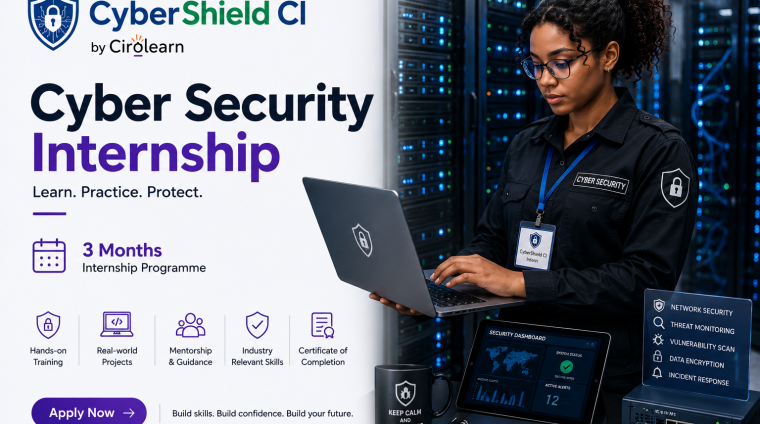
Cybersecurity Internship Program
Cybersecurity is the practice of protecting computer systems, networks, applications, and digital data from cyber threats, attacks, unauthorized access, and security breaches.
As businesses and organizations continue to operate digitally, cybersecurity has become one of the most important areas in technology. Companies use cybersecurity to protect sensitive information, secure digital systems, prevent cyber attacks, and maintain safe online operations.
Today, cybersecurity is used to:
- Protect websites and applications
- Secure user data and accounts
- Prevent hacking and cyber attacks
- Monitor system vulnerabilities
- Improve digital security
- Maintain safe business operations
The Cirolearn Cybersecurity Internship Program is designed to give students practical experience in modern cybersecurity practices, ethical hacking, digital protection, and security analysis through hands-on projects and real internship simulation.
During the internship, students will learn:
- Introduction to Cybersecurity
- Network security fundamentals
- Ethical hacking basics
- Cyber threat awareness
- Vulnerability assessment
- Web application security
- Password and authentication security
- Linux fundamentals
- Security tools and monitoring
- Cybersecurity best practices
Interns will work on practical projects such as:
- Security analysis projects
- Vulnerability testing simulations
- Secure authentication systems
- Website security assessments
- Network monitoring exercises
- Cybersecurity awareness projects
The internship is structured like a real security operations environment where students collaborate in teams, analyze security risks, identify vulnerabilities, and apply modern cybersecurity practices to protect digital systems.
At the end of the program, all student projects and assessments will go through a professional verification and evaluation process to ensure interns have gained practical security skills and real technical understanding.
Projects and performance will be reviewed based on:
- Technical understanding
- Security analysis ability
- Problem-solving skills
- Vulnerability identification
- Team collaboration
- Professional conduct
- Final project presentation
Students who score above 80% after verification will qualify for the:
Cirolearn Talent Placement Program
Top-performing interns will gain access to:
-
- Verified job opportunities with our startup partners
- Freelance design projects from trusted partner companies
- Advanced internship placements with leading industry teams
The goal of the program is to help students become industry-ready cybersecurity professionals capable of protecting digital systems, identifying security risks, and supporting safe and secure online operations for modern businesses and organizations.
- 12 Sections
- 36 Lessons
- 12 Weeks
- Week 1 – Computer & Cybersecurity FundamentalsCybersecurity Fundamentals introduces learners to the core concepts of cybersecurity and digital protection. Participants will learn how to identify cyber threats, secure computer systems and networks, protect sensitive data, and apply industry best practices for preventing cyberattacks. This module provides the essential knowledge and practical foundation needed to begin a successful career in cybersecurity.3
- Week 2 – Networking EssentialsNetworking Essentials Learn the fundamentals of computer networking that power modern digital communication. In this module, interns will explore key networking concepts, including network types, IP addressing, network devices, common protocols, and the OSI and TCP/IP models. By the end of the module, participants will understand how data travels across networks and build the networking knowledge required for cybersecurity analysis and defense.3
- Week 3 – Linux & Windows AdministrationOperating System Administration & Security Build practical skills in administering and securing Linux and Windows systems. In this module, interns will learn Linux file permissions, process and service management, Bash scripting fundamentals, and task automation. They will also explore Windows security, use Event Viewer to analyze system logs, and learn PowerShell basics for system administration. Through hands-on exercises, participants will write Linux scripts to automate routine tasks and strengthen their operating system management skills.3
- Week 4 – Python for CybersecurityPython for Cybersecurity Develop essential Python programming skills for cybersecurity and automation. In this module, interns will learn Python fundamentals, including variables, functions, loops, file handling, and modules. They will then apply these concepts to networking, work with the Requests library, and automate basic security tasks. Through a hands-on project, participants will build a simple port scanner to reinforce their programming, networking, and cybersecurity skills.3
- Week 5 – Ethical Hacking FundamentalsReconnaissance & Information Gathering Discover the first phase of ethical hacking by learning how security professionals gather intelligence on target systems. In this module, interns will explore the penetration testing process, Open-Source Intelligence (OSINT), Google Dorking, and popular reconnaissance tools such as theHarvester and Recon-ng. Through practical exercises, participants will conduct information gathering to identify publicly available data and better understand an organization's external attack surface.3
- Week 6 – Network Scanning & EnumerationLearn how to discover and assess systems within a network using industry-standard reconnaissance tools. In this module, interns will use Nmap, Netcat, and banner grabbing techniques to identify live hosts, open ports, running services, and potential vulnerabilities. Through hands-on practice, participants will scan a lab environment and perform basic vulnerability enumeration to prepare for security assessments.3
- Week 7 – Vulnerability AssessmentVulnerability Assessment Learn how to identify, analyze, and prioritize security weaknesses in systems and applications. In this module, interns will explore vulnerabilities, understand CVEs and CVSS scoring, and use industry-standard tools such as Nessus, OpenVAS, and Nikto to perform vulnerability assessments. Through hands-on practice, participants will scan a lab environment and generate a professional vulnerability report with findings and remediation recommendations.3
- Week 8 – Web Application SecurityWeb Application Security Learn the fundamentals of web application security and the most common vulnerabilities affecting modern websites. In this module, interns will explore HTTP, cookies, and sessions, study the OWASP Top 10 security risks, and understand attacks such as SQL Injection, Cross-Site Scripting (XSS), and Cross-Site Request Forgery (CSRF). Through hands-on labs with Burp Suite, participants will identify and analyze web application vulnerabilities in a safe, controlled environment.3
- Week 9 – Password & Wireless SecurityPassword & Wireless Security Explore the principles of password security and wireless network protection. In this module, interns will learn about password attacks, hashing techniques, and the use of tools such as Hashcat, Hydra, and John the Ripper for password auditing in authorized environments. They will also study wireless security concepts, including WPA authentication and rogue access points. Through a practical lab, participants will perform password auditing and understand how to identify and mitigate common authentication weaknesses.3
- Week 10 – SOC & Incident ResponseSecurity Operations & Incident Response Gain practical experience in monitoring, detecting, and responding to cybersecurity incidents. In this module, interns will explore the role of a Security Operations Center (SOC), learn the fundamentals of Security Information and Event Management (SIEM), and work with industry tools such as Splunk and Wazuh. They will also study the Incident Response Lifecycle and develop log analysis skills to identify suspicious activities. Through hands-on exercises, participants will investigate security logs and understand how security teams detect, analyze, and respond to cyber threats.3
- Week 11 – Cloud Security & Digital ForensicsCloud Security & Digital Forensics Learn the fundamentals of securing cloud environments and investigating cybersecurity incidents. In this module, interns will explore AWS and Azure security, Identity and Access Management (IAM), and the principles of digital forensics. They will gain hands-on experience with evidence collection using FTK Imager, perform basic memory analysis with Volatility, and understand the fundamentals of malware analysis. Through a practical investigation, participants will apply forensic techniques to collect, preserve, and analyze digital evidence in a controlled lab environment.3
- Week 12 – Capstone Project & Career PreparationCapstone Project & Career Development Conclude the internship by applying the knowledge and skills gained throughout the program in a real-world cybersecurity project. In this module, interns will perform a secure network assessment, develop and present a capstone project, and receive professional career preparation. Sessions include CV writing, LinkedIn profile optimization, interview preparation, and mock technical interviews to help participants confidently pursue internships and entry-level cybersecurity roles. The program concludes with the CyberShield CI Internship Closing Ceremony and certificate presentation.3

Login with your site account
Not a member yet? Register now
Register a new account
Are you a member? Login now